At RIX Church, we believe Christianity is not built on personality, culture, popularity, or human authority.
It is built on Jesus Christ.
Our goal is to teach Scripture clearly, encourage Christians to think carefully about what they believe, and remain faithful to Christ with humility, courage, love, and service.
Our Purpose
RIX Church exists to point people toward Christ, encourage serious engagement with Scripture, and help Christians develop faith that is thoughtful, courageous, humble, and rooted in truth.
We do not believe Christianity requires surrendering reason.
We do not believe humility requires surrendering conviction.
We do not believe disagreement requires hatred.
We believe Christians should be known not merely by what they oppose, but by how faithfully they serve Christ and one another.
Above every pastor, ministry, denomination, culture, and institution stands Jesus Christ.
“For other foundation can no man lay than that is laid, which is Jesus Christ.”
— 1 Corinthians 3:11
Christ above culture.
Truth without pride.
Conviction without contempt.
Service before status.
Faithfulness until Christ returns.
1. The Bible
We believe the Holy Scriptures are the foundation for Christian faith and teaching.
Scripture should be read seriously, studied carefully, and tested against Scripture itself.
No pastor, teacher, denomination, tradition, ministry, or individual stands above the Word of God.
“All scripture is given by inspiration of God, and is profitable for doctrine, for reproof, for correction, for instruction in righteousness.”
— 2 Timothy 3:16
2. God and the Trinity
We believe in one God, eternally existing as Father, Son, and Holy Spirit.
The Father is God. The Son is God. The Holy Spirit is God.
They are not three gods, but one God.
We recognize that the mystery of God’s nature is greater than human understanding, yet we accept what Scripture reveals about the Father, the Son, and the Holy Spirit.
“Go ye therefore, and teach all nations, baptizing them in the name of the Father, and of the Son, and of the Holy Ghost.”
— Matthew 28:19
3. Jesus Christ
We believe Jesus Christ is God.
He is the eternal Son of God, fully divine, who took on human flesh and came into the world for our salvation.
Jesus Christ is not merely a prophet, teacher, moral example, or created being.
He is Lord.
“In the beginning was the Word, and the Word was with God, and the Word was God.”
— John 1:1
“And the Word was made flesh, and dwelt among us.”
— John 1:14
We believe He lived without sin, died for our sins, rose bodily from the dead, ascended into heaven, and will come again.
Our faith, hope, worship, and salvation are centered on Jesus Christ.
“And Thomas answered and said unto him, My Lord and my God.”
— John 20:28
4. The Holy Spirit
We believe the Holy Spirit is God and is active in the life of the believer.
The Holy Spirit convicts of sin, leads believers toward truth, strengthens us in our walk with Christ, and helps us live lives that reflect the character of God.
We believe spiritual gifts should be approached with humility, discernment, and submission to Scripture.
“Howbeit when he, the Spirit of truth, is come, he will guide you into all truth.”
— John 16:13
5. Salvation
We believe salvation is found through Jesus Christ.
Man cannot save himself through status, achievement, wealth, intelligence, family background, or human works.
Salvation is the work of God, received through faith in Christ.
“For by grace are ye saved through faith; and that not of yourselves: it is the gift of God.”
— Ephesians 2:8
6. Repentance and a Changed Life
We believe Christian faith should produce repentance and transformation.
Christianity is not merely agreeing with certain doctrines.
Following Christ should change the way we live, speak, treat others, use authority, handle money, raise families, forgive, serve, and respond to sin.
“If any man be in Christ, he is a new creature.”
— 2 Corinthians 5:17
7. Baptism
We believe baptism should follow a personal confession of faith in Jesus Christ.
Throughout the New Testament, baptism is closely connected with hearing the Gospel, believing, and repentance.
“Repent, and be baptized every one of you in the name of Jesus Christ for the remission of sins.”
— Acts 2:38
For this reason, we practice baptism after a person is able to understand the Gospel, repent, and personally place faith in Christ.
We do not practice infant baptism.
We believe infants and very young children are innocent of deliberate personal rebellion against God and are entrusted fully to His mercy and care.
Because an infant cannot yet consciously repent, confess Christ, or make a personal profession of faith, we believe baptism is properly received when that personal faith becomes possible.
“Suffer the little children to come unto me, and forbid them not: for of such is the kingdom of God.”
— Mark 10:14
We recognize that sincere Christians and historic Christian traditions understand baptism differently.
Our purpose is not to condemn those traditions, but to practice baptism according to our understanding of Scripture:
Faith, repentance, and then baptism.
8. Communion / The Lord’s Supper
We believe Christians should observe the Lord’s Supper in remembrance of Jesus Christ, His sacrifice, and the new covenant established through Him.
Communion should be approached with reverence, gratitude, self-examination, and unity with fellow believers.
We recognize that Christians differ in how they understand the exact nature of Christ’s presence in Communion, and we do not wish to make those differences a cause of unnecessary hostility among believers.
“This do in remembrance of me.”
— 1 Corinthians 11:24
9. The Church
We believe Christians are called into fellowship with one another.
The church should teach truth, care for people, encourage spiritual growth, correct with humility, and point people toward Christ.
We also believe no local congregation or denomination is identical with the entire Body of Christ.
Christ remains the head of His Church.
“And he is the head of the body, the church.”
— Colossians 1:18
10. Christian Leadership
We believe pastors and Christian leaders should be respected, but spiritual leadership is service rather than domination.
Pastors are shepherds.
They are not owners of another Christian’s conscience.
Leaders should teach faithfully, lead humbly, and remember that they themselves remain accountable to Christ.
“Neither as being lords over God’s heritage, but being ensamples to the flock.”
— 1 Peter 5:3
11. Scripture and Discernment
We believe Christians have a responsibility to examine what they are taught.
Respect for a teacher does not eliminate personal discernment.
Like the Bereans, Christians should receive teaching willingly while examining Scripture to determine whether those things are true.
“They received the word with all readiness of mind, and searched the scriptures daily, whether those things were so.”
— Acts 17:11
12. Christian Disagreement
We believe Christians can disagree without becoming enemies.
Truth matters.
Doctrine matters.
But disagreement should not become hatred, pride, contempt, or endless fighting.
“And the servant of the Lord must not strive; but be gentle unto all men, apt to teach, patient, in meekness instructing those that oppose themselves.”
— 2 Timothy 2:24–25
Strong convictions without contempt.
Respect without surrender.
Disagreement without hatred.
13. Christian Unity
We believe genuine Christians may disagree on important theological questions while still recognizing one another as brothers and sisters in Christ.
Unity does not require pretending differences do not exist.
It requires putting Christ above our pride and treating other believers with charity.
“Endeavouring to keep the unity of the Spirit in the bond of peace.”
— Ephesians 4:3
14. Culture and Christianity
We believe no human culture perfectly represents Christianity.
Every nation and culture contains things that are good and things that must be corrected by Christ.
Christianity should not simply become an expression of national identity, politics, social class, or cultural preference.
Our question should always be: What does Christ require of us?
15. Humility and Conviction
We believe humility does not mean weakness.
A Christian can be humble and still hold strong convictions.
We do not need to boast about ourselves, dominate others, or win every argument.
We should know what we believe, remain willing to be corrected, and stand firmly when conscience and Scripture require it.
“Let nothing be done through strife or vainglory; but in lowliness of mind let each esteem other better than themselves.”
— Philippians 2:3
16. Love of Neighbor
We believe Christians are commanded to love God and love their neighbor.
That love should influence the way we speak, lead, work, disagree, exercise authority, and treat people who cannot benefit us.
“Thou shalt love thy neighbour as thyself.”
— Matthew 22:39
Christian love does not require agreement with everything another person believes.
But it does require recognizing their dignity.
17. Marriage and Family
We believe marriage is a covenant between one man and one woman.
We believe the family is ordinarily formed around father, mother, and children, with each carrying responsibilities before God.
We believe the husband and father carries a responsibility of leadership, provision, protection, and sacrificial service within the household.
We believe the wife and mother is an equal bearer of dignity before God and an essential partner in the life, care, stability, and upbringing of the family.
We believe children are to be loved, protected, taught, disciplined with wisdom, and raised in the knowledge of God.
We understand family order not as a license for domination, pride, cruelty, or control, but as a structure of responsibility and service.
Christian leadership in the home should follow the example of Christ: authority expressed through sacrifice, love, patience, and care.
“Therefore shall a man leave his father and his mother, and shall cleave unto his wife: and they shall be one flesh.”
— Genesis 2:24
“Husbands, love your wives, even as Christ also loved the church, and gave himself for it.”
— Ephesians 5:25
“Children, obey your parents in the Lord: for this is right.”
— Ephesians 6:1
“And, ye fathers, provoke not your children to wrath: but bring them up in the nurture and admonition of the Lord.”
— Ephesians 6:4
We believe biblical family order is a hierarchy of responsibility, not a hierarchy of human worth.
Father, mother, and children have different roles, but every member of the family possesses dignity before God.
18. Prosperity, Wealth, and Stewardship
We do not believe material wealth is proof of greater faith, greater holiness, or greater favor from God.
We also do not believe wealth itself is sinful.
A Christian may have much or little.
The question is not simply how much a person has, but what he does with what God has placed in his hands.
“For the love of money is the root of all evil.”
— 1 Timothy 6:10
Money is a tool.
It can feed a family, support a church, help a brother or sister in need, support missionaries, care for the poor, create work, provide shelter, and accomplish many good things.
For this reason, we believe a Christian may become wealthy while still living faithfully before God.
But wealth should never become a reason for pride.
A Christian should not use money to prove his importance, display superiority, or measure God’s love for him.
“Charge them that are rich in this world, that they be not highminded, nor trust in uncertain riches, but in the living God…”
— 1 Timothy 6:17
“That they do good, that they be rich in good works, ready to distribute, willing to communicate.”
— 1 Timothy 6:18
We believe Christians should handle money with gratitude, wisdom, generosity, and meekness.
There is nothing wrong with enjoying the good things God provides.
But enjoyment should never become worship.
Possession should never become identity.
Success should never become pride.
“For unto whomsoever much is given, of him shall be much required.”
— Luke 12:48
Money should be in the Christian’s hand, not in the Christian’s heart.
Our goal is not poverty for the sake of appearing holy.
Neither is our goal wealth for the sake of appearing blessed.
Our goal is faithfulness with whatever God gives us.
19. Creation
We believe God is the Creator of heaven and earth and that all creation ultimately belongs to Him.
Human life has dignity because mankind was created by God and bears His image.
We believe Christians should receive creation with gratitude and exercise responsible stewardship over what God has entrusted to us.
We do not believe debates over every scientific or chronological detail of creation should become a reason for unnecessary division among Christians who affirm God as Creator.
“In the beginning God created the heaven and the earth.”
— Genesis 1:1
20. Heaven, Hell, and Final Judgment
We believe earthly life is not the end.
We believe in resurrection, final judgment, eternal life with God, and the reality of separation from God.
We believe salvation is found in Jesus Christ and that every person should take seriously the call to repentance and faith.
We do not teach these things to create fear for its own sake, but because Scripture calls us to live with eternity in view.
“And these shall go away into everlasting punishment: but the righteous into life eternal.”
— Matthew 25:46
21. Satan and Spiritual Warfare
We believe Satan and spiritual evil are real.
At the same time, we do not believe Christians should live in fear, obsession, or superstition.
Our confidence is in Christ.
Spiritual warfare should be approached through faith, prayer, truth, righteousness, Scripture, and dependence upon God.
“Submit yourselves therefore to God. Resist the devil, and he will flee from you.”
— James 4:7
We believe Christ is greater than every power of darkness.
22. Missions and Evangelism
We believe Christians are called to share the Gospel and make disciples.
Evangelism should be truthful, compassionate, patient, and respectful.
We do not believe people should be manipulated, pressured, or treated as projects.
We proclaim Christ and trust God with the response.
“Go ye therefore, and teach all nations.”
— Matthew 28:19
We believe Christian mission also includes practical service, generosity, mercy, and care for those in need.
23. Church Membership and Discipline
We believe Christians should take fellowship and accountability seriously.
A healthy church should encourage believers, teach Scripture, correct serious sin when necessary, and seek restoration rather than humiliation.
Church discipline should never become a tool for personal revenge, control, public embarrassment, or suppression of honest disagreement.
Correction should be carried out carefully, fairly, and with the goal of repentance and restoration.
“Brethren, if a man be overtaken in a fault, ye which are spiritual, restore such an one in the spirit of meekness.”
— Galatians 6:1
24. The Rapture and Tribulation
We believe Jesus Christ will return.
Scripture calls Christians to live with expectation, faithfulness, and readiness for His coming.
“Therefore be ye also ready: for in such an hour as ye think not the Son of man cometh.”
— Matthew 24:44
Among faithful Christians, there are different interpretations concerning the timing of the rapture and the tribulation.
Some believe the Church will be gathered to Christ before the tribulation.
Others believe Christians will remain through the tribulation and be gathered to Christ afterward.
At RIX Church we believe Christians can faithfully hold either a pre-tribulation or post-tribulation understanding.
We do not desire to make the timing of the rapture a source of division among believers.
Christ told us to be ready.
He also told us to serve.
Our greater concern is not, “Will Christ remove us before suffering begins?” but, “Will Christ find us faithful when He comes?”
Whether a Christian expects to be taken before tribulation or believes the Church may endure it, our responsibility today remains the same:
- Love God.
- Love our neighbor.
- Preach the Gospel.
- Serve others.
- Care for our families.
- Help those in need.
- Remain faithful to Christ.
“Blessed is that servant, whom his lord when he cometh shall find so doing.”
— Matthew 24:46
We can study prophecy seriously without allowing speculation about timelines to overshadow the work Christ has already placed before us.
Our focus is not fear of tribulation. Our focus is faithful service until Christ returns.
25. Deliverance
We believe Jesus Christ has authority over sin, darkness, and every spiritual power.
We believe Christians may pray for deliverance when a person is experiencing spiritual oppression, bondage, or patterns that keep them from walking freely and faithfully with Christ.
Deliverance should always point a person toward Jesus Christ, repentance, prayer, Scripture, and a life of obedience to God.
We do not believe Christians should become obsessed with demons, assume that every difficulty is caused by a spirit, or use fear and sensationalism in ministry.
Our attention belongs primarily on Christ, not on darkness.
“If the Son therefore shall make you free, ye shall be free indeed.”
— John 8:36
“And these signs shall follow them that believe; In my name shall they cast out devils…”
— Mark 16:17
We believe prayer for deliverance should be approached with humility, discernment, compassion, and submission to Scripture.
It should never be used to frighten, shame, control, or exploit another person.
We also recognize that emotional, physical, relational, and mental struggles can have many causes. Seeking wise pastoral, medical, or professional help when appropriate is not contrary to faith.
Our confidence is not in a method, personality, or ministry technique. Our confidence is in Jesus Christ.
Deliverance should lead to freedom, discipleship, and a deeper life of obedience to Christ.
26. Healing and Spiritual Gifts
We believe God still heals and that the gifts of the Holy Spirit remain active according to His will.
We believe Christians may pray for healing, spiritual gifts, wisdom, discernment, prophecy, tongues, interpretation, and other gifts described in Scripture.
“Now there are diversities of gifts, but the same Spirit.”
— 1 Corinthians 12:4
We believe these gifts are given for the good of the Church, not for personal status, entertainment, or spiritual pride.
“But the manifestation of the Spirit is given to every man to profit withal.”
— 1 Corinthians 12:7
We believe healing should be prayed for with faith, humility, and compassion.
At the same time, we do not believe that a person who remains sick necessarily lacks faith, has hidden sin, or has failed spiritually.
God is sovereign, and we do not claim to understand why some people are healed immediately, some gradually, and others not in the way we hope.
We believe Christians may pray boldly while remaining humble before God’s will.
We also believe seeking medical care is not contrary to faith. Prayer and appropriate medical treatment do not need to be enemies.
We believe spiritual gifts must be exercised with order, discernment, love, and accountability to Scripture.
“Let all things be done decently and in order.”
— 1 Corinthians 14:40
No spiritual gift makes one Christian more important than another.
Paul teaches that the Church is one body with many members, each serving a different purpose.
We therefore reject the use of spiritual gifts for boasting, manipulation, financial exploitation, or creating a personality cult around a minister.
The purpose of spiritual gifts is not to make the servant impressive. It is to build up the Body of Christ and glorify God.
We pray for healing. We welcome the gifts of the Spirit. We test what we hear against Scripture. And we keep Jesus Christ at the center.
27. False Teachers, Division, and Disorder
We believe Christians are called to exercise discernment and to guard the Church against false teaching, deception, unnecessary division, and deliberate disorder.
Jesus warned:
“Beware of false prophets, which come to you in sheep’s clothing, but inwardly they are ravening wolves.”
— Matthew 7:15
Not everyone who speaks in the name of Christ speaks truthfully.
For this reason, teachers, pastors, ministries, and spiritual claims should be tested against Scripture.
We believe Christians should be especially cautious of teachers who use fear, pride, money, manipulation, personal loyalty, or claims of special spiritual authority to control others.
At the same time, we do not believe every disagreement makes someone a false teacher.
A Christian may question a teaching, disagree with leadership, or ask difficult questions without being rebellious or divisive.
Discernment must work in both directions: we must guard against false teaching without using the accusation of “division” to silence honest believers.
Scripture also warns against those who intentionally create division:
“Now I beseech you, brethren, mark them which cause divisions and offences contrary to the doctrine which ye have learned; and avoid them.”
— Romans 16:17
We believe correction should normally begin with patience, conversation, and an opportunity for repentance.
“A man that is an heretick after the first and second admonition reject.”
— Titus 3:10
We distinguish between a sincere person who disagrees and someone whose purpose is repeatedly to provoke, disrupt, mock, derail teaching, or create hostility within the ministry.
Questions are welcome.
Honest disagreement is welcome.
Correction from Scripture is welcome.
But deliberate disruption should not be allowed to prevent others from learning, worshiping, or receiving ministry peacefully.
Paul writes:
“But foolish and unlearned questions avoid, knowing that they do gender strifes.”
— 2 Timothy 2:23
And immediately afterward:
“And the servant of the Lord must not strive; but be gentle unto all men, apt to teach, patient.”
— 2 Timothy 2:24
Therefore, even when confronting false teaching or disruptive behavior, Christian leaders should not become quarrelsome themselves.
We believe ministry leadership has a responsibility to protect the congregation while remaining humble, fair, and accountable to Scripture.
We will not fear honest questions.
We will not confuse disagreement with rebellion.
But we will also not allow deception, manipulation, deliberate division, or persistent disruption to take control of the ministry.
Our purpose is not to protect personalities or human authority.
Our purpose is to protect faithful teaching, Christian fellowship, and the work Christ has entrusted to His Church.
28. Sin, Repentance, Free Will, and Perseverance
We believe all people are sinners and need the grace of God through Jesus Christ.
“For all have sinned, and come short of the glory of God.”
— Romans 3:23
We believe salvation is received through faith in Jesus Christ, but the Christian life does not end at the moment of conversion.
A believer is still capable of choosing sin.
For this reason, we do not teach that a person can knowingly turn away from Christ, persist in unrepentant sin, and rely on a past profession of faith as though repentance no longer matters.
We do not believe in “once saved, always saved” in the sense that a believer no longer has any responsibility to remain faithful to Christ.
Scripture repeatedly calls believers to continue in faith, resist sin, repent when they fall, and remain faithful.
“If we confess our sins, he is faithful and just to forgive us our sins, and to cleanse us from all unrighteousness.”
— 1 John 1:9
We believe God has given human beings genuine moral responsibility.
We can choose obedience.
We can choose sin.
And when we sin, we can choose to humble ourselves, turn back to God, and repent.
Repentance is not something Christians should fear.
It is one of God’s great gifts to us.
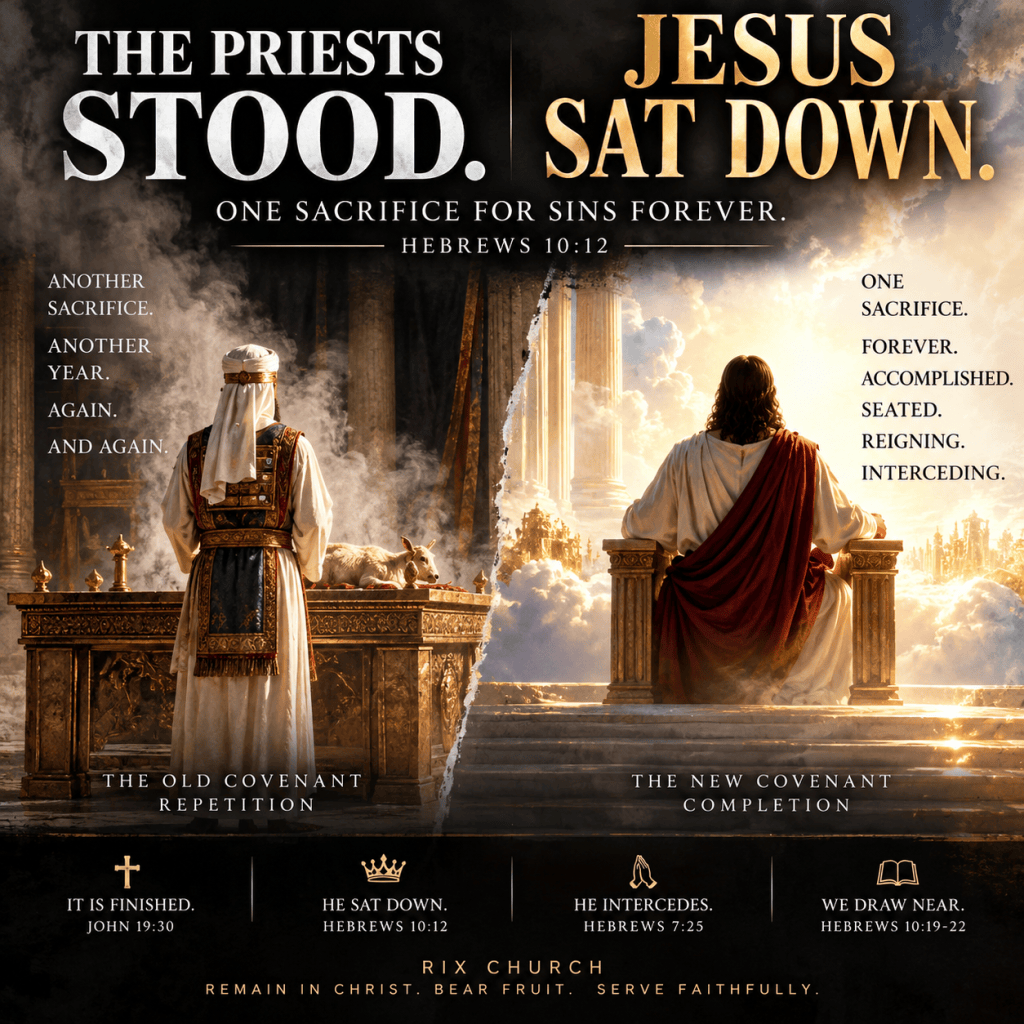
Through Jesus Christ, the way to God has been opened.
When Christ died, the veil of the temple was torn:
“And, behold, the veil of the temple was rent in twain from the top to the bottom.”
— Matthew 27:51
Because of Christ, we do not need another human being to stand between us and God in order to seek forgiveness.
We may come directly before Him through Jesus Christ.
“Let us therefore come boldly unto the throne of grace, that we may obtain mercy, and find grace to help in time of need.”
— Hebrews 4:16
This does not make sin unimportant.
It makes repentance accessible.
When a Christian falls, the answer is not hopelessness.
The answer is not pretending the sin did not happen.
The answer is not pride.
The answer is to return to God.
Confess.
Repent.
Receive His mercy.
And continue walking with Christ.
We believe repentance should produce a genuine turning of the heart and, where possible, a change in behavior.
“For godly sorrow worketh repentance to salvation not to be repented of.”
— 2 Corinthians 7:10
We also believe Christians should not live in constant terror that every failure has instantly separated them from God.
Our confidence is in the mercy and faithfulness of Christ.
But grace should never become an excuse to deliberately continue in sin.
“What shall we say then? Shall we continue in sin, that grace may abound? God forbid.”
— Romans 6:1–2
We are saved by grace through faith.
We remain responsible for how we respond to that grace.
When we sin, we repent.
When we fall, we return to Christ.
And because the veil has been torn, we may come directly to God through Jesus Christ for mercy, forgiveness, and restoration.
29. Resurrection of Believers
We believe those who belong to Christ will be raised to eternal life.
“Because I live, ye shall live also.”
— John 14:19
Our hope is not only for this life, but in the resurrection and eternal life promised through Jesus Christ.
30. Prayer and Fasting
We believe prayer is essential to the Christian life, and fasting can be a valuable act of devotion, repentance, discernment, and dependence upon God.
“Watch and pray, that ye enter not into temptation.”
— Matthew 26:41
Prayer and fasting should draw us closer to God, not become a performance before others.
31. Sanctification and Holiness
We believe Christians are called to grow in holiness throughout their lives.
“But as he which hath called you is holy, so be ye holy in all manner of conversation.”
— 1 Peter 1:15
Salvation begins a life of transformation in which the Holy Spirit helps us become more like Christ.
32. Forgiveness and Reconciliation
We believe Christians are called to forgive others as God has forgiven us.
“And be ye kind one to another, tenderhearted, forgiving one another.”
— Ephesians 4:32
Where possible, we seek peace and reconciliation, while recognizing that forgiveness does not require ignoring serious wrongdoing or removing necessary boundaries.
33. Service to the Poor and Vulnerable
We believe Christian faith should produce practical compassion.
“Let us not love in word, neither in tongue; but in deed and in truth.”
— 1 John 3:18
Christians should care for the poor, vulnerable, lonely, sick, and those experiencing genuine need.
34. Religious Liberty and Conscience
We believe faith should be freely embraced, not forced through coercion, fear, or manipulation.
“So then every one of us shall give account of himself to God.”
— Romans 14:12
We seek to persuade through truth and love while respecting the conscience and responsibility of each person before God.
35. Testing Prophecy and Spiritual Claims
We believe spiritual claims should be tested rather than accepted blindly.
“Prove all things; hold fast that which is good.”
— 1 Thessalonians 5:21
We do not despise prophecy or spiritual gifts, but every teaching, prophecy, vision, or spiritual claim must remain accountable to Scripture and careful discernment.
“Beloved, believe not every spirit, but try the spirits whether they are of God.”
— 1 John 4:1
36. Spiritual Gifts Are Not for Sale
We believe the gifts and power of God must never be commercialized.
“Thy money perish with thee, because thou hast thought that the gift of God may be purchased with money.”
— Acts 8:20
Healing, prophecy, deliverance, prayer, and spiritual authority should never be sold, manipulated for financial gain, or used to exploit vulnerable people.
Ministry should serve people, not turn their spiritual needs into a business opportunity.
37. Restoration After Failure
We believe Christians who fall into sin should be called to genuine repentance, but repentance should also open the door to forgiveness and restoration.
“Restore such an one in the spirit of meekness.”
— Galatians 6:1
Correction should seek restoration rather than humiliation.
We believe failure does not have to become a person’s permanent identity when there is sincere repentance, accountability, and changed behavior.
Truth requires correction. Grace makes restoration possible.
38. Giving and Supporting the Ministry
We believe giving should come freely from the heart, not through pressure, guilt, or coercion.
Although those serving in RIX Church have regular employment and do not depend upon the ministry for personal income, gathering and serving in person still brings ordinary earthly expenses.
These may include venue costs, electricity and utilities, food and coffee, ministry materials, equipment, transportation, and other practical expenses involved in bringing people together.
Scripture teaches:
“Every man according as he purposeth in his heart, so let him give; not grudgingly, or of necessity: for God loveth a cheerful giver.”
— 2 Corinthians 9:7
For this reason, we simply ask those who desire to support the ministry to give whatever the Lord has placed upon their heart and according to their ability.
We will not require a tithe.
We will not pressure anyone into recurring giving or subscriptions.
We will not measure a person’s faith by how much money they give.
And financial giving will never determine someone’s importance or standing within the ministry.
Giving is voluntary.
If someone is unable to give, they are still welcome to worship, learn, pray, fellowship, and receive ministry alongside everyone else.
Those who are able and feel led to contribute help us meet the practical costs of serving together.
The purpose of giving is not to enrich the ministry or its leaders. It is to provide the practical resources needed to serve people and continue the work.
Give freely. Give according to your ability. Give as the Lord places upon your heart. And never give because you were pressured to do so.







You must be logged in to post a comment.